

Sanjana H
CTO, Pier39.ai
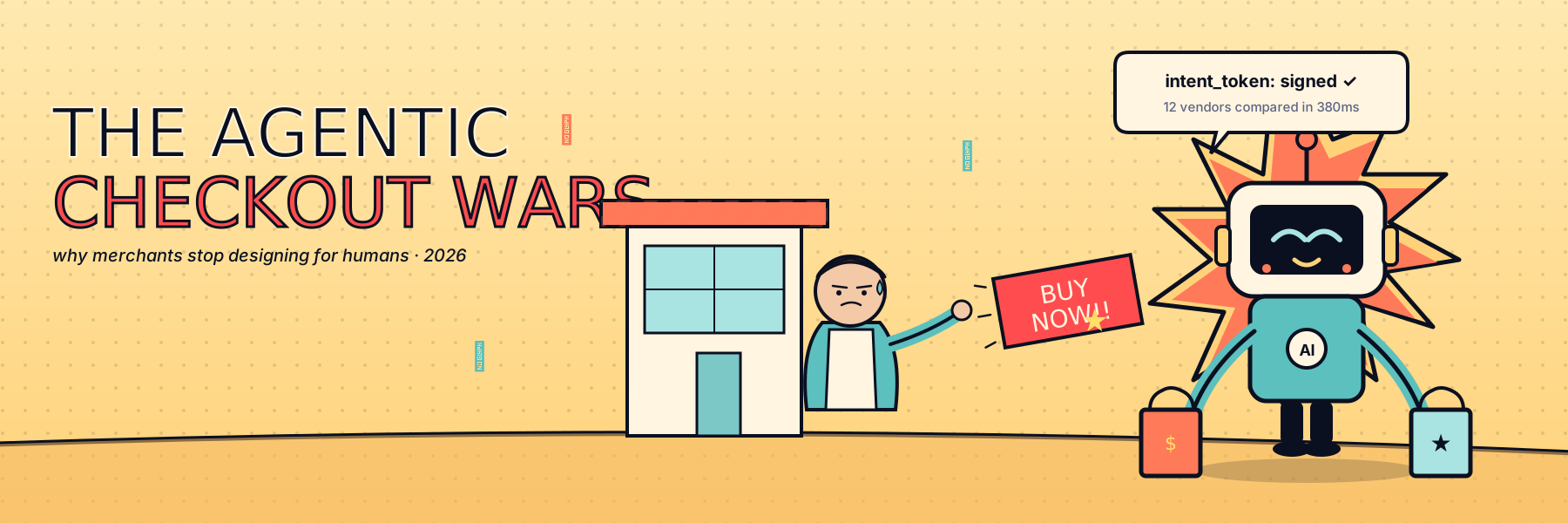
The Agentic Checkout Wars: Why 2026 Is the Year Merchants Stop Designing for Humans
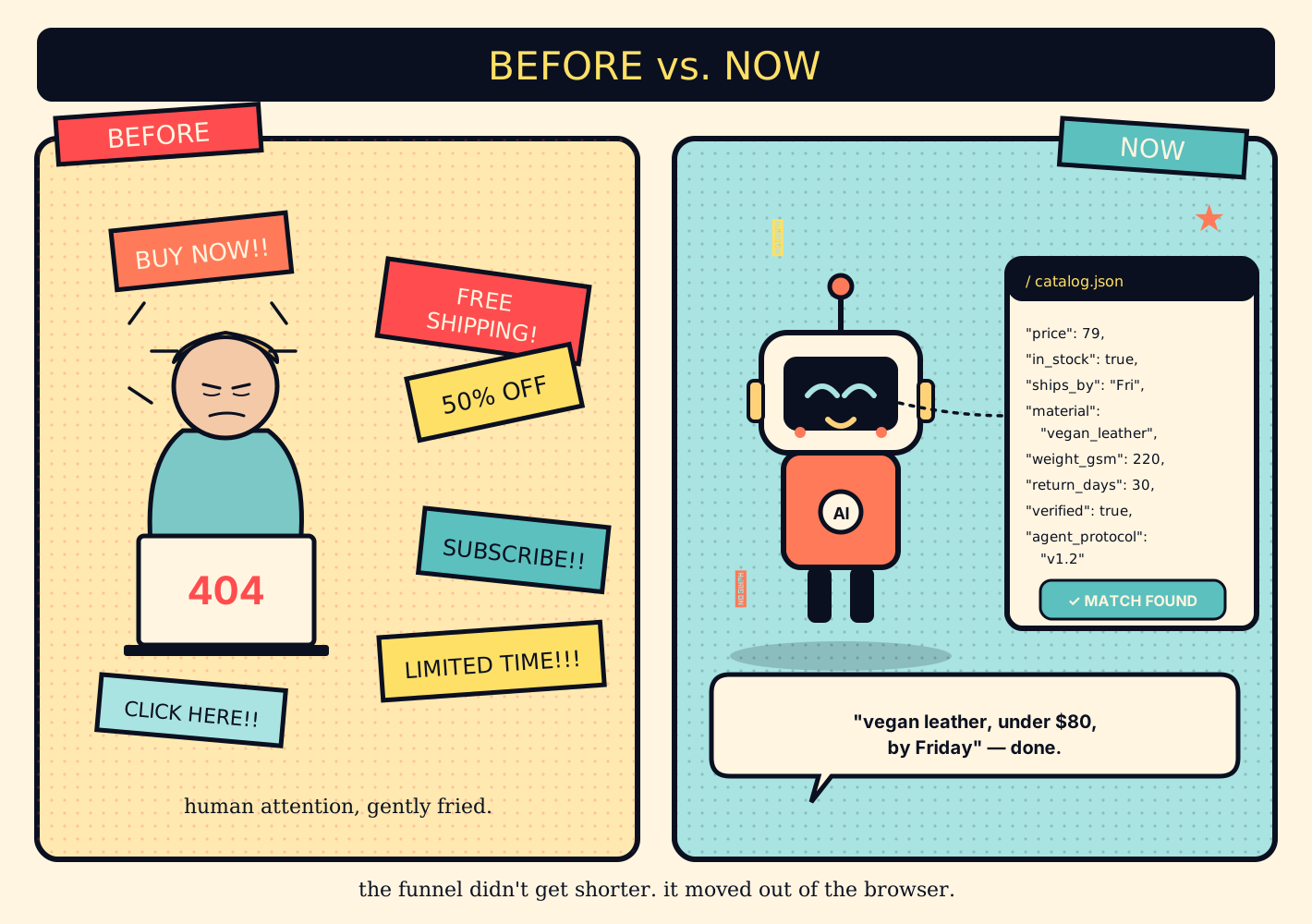
For two decades, every dollar spent on e-commerce UX optimization assumed the same thing: a human was on the other end of the screen. Bigger “Buy Now” buttons. Fewer form fields. Trust badges above the fold. Cart abandonment emails timed to the minute. The entire discipline of conversion rate optimization was a long argument with human attention.
That argument is ending. The buyer on the other end of the screen, increasingly, is not looking at the screen at all.
What changed
In the last twelve months, the major payment networks and platforms have all shipped infrastructure designed for one explicit use case: an autonomous AI agent making a purchase on behalf of a human. Visa’s Intelligent Commerce, Mastercard’s Agent Pay, PayPal’s Agent Toolkit, Stripe’s agent-aware checkout, and OpenAI’s Instant Checkout inside ChatGPT are no longer pilots. They are production rails moving real volume. The protocols differ in detail, but they converge on the same primitives: a verifiable agent identity, a scoped payment credential, a structured product feed the agent can read without rendering a webpage, and a cryptographic handshake that lets the merchant and the issuing bank both confirm the human delegated this purchase.
The reason this matters is that none of it requires a browser. The agent does not click. It does not see your hero image. It does not get nudged by your free-shipping threshold copy. It reads a structured catalog, evaluates against a constraint the user gave it (“under $80, ships before Friday, vegan leather”), and submits a transaction. The conversion funnel as a visual artifact is gone.
The new shelf is a feed
The first concrete shift merchants are making is treating their product catalog as the product, not the storefront. If an agent is going to compare you against eleven other vendors in a few hundred milliseconds, what matters is the completeness, accuracy, and machine-readability of your data — sizing in normalized units, materials in controlled vocabulary, return policy parsed into days and conditions, in-stock status timestamped to the minute. The merchants winning early agentic traffic are the ones whose feeds answer questions before they’re asked.
This is not SEO with a coat of paint. SEO optimized for what a human would type into a search box and then squint at on a results page. Agent optimization is closer to API design. The agent has a schema in mind and is filling slots. If your description says “buttery soft” where the schema wants a fabric weight in GSM, you don’t get filtered out for being unpoetic — you get filtered out for being unparseable.
Trust moves into the protocol
The second shift is harder for merchants to see because it happens off their site entirely. When a user tells their agent “buy this,” the agent has to prove three things to the merchant’s payment processor: that it is the agent it claims to be, that the user authorized this specific purchase or a budget that contains it, and that the agent has not been hijacked or prompt-injected mid-task. The networks have answered with signed agent credentials, intent tokens that bind a transaction to a delegation scope, and step-up verification when the purchase exceeds the user’s pre-authorized envelope.
The practical consequence is that “trust” stops being a thing the merchant builds with logos and reviews and starts being a thing the protocol asserts. A merchant can no longer earn trust at checkout, because there is no checkout to earn it on. Trust is now upstream — in whether your storefront is verified by the network, whether your dispute resolution is machine-readable, whether your return flow can be initiated by the same agent that bought the item.
The discovery problem nobody is solving yet
Here is where it gets uncomfortable for incumbents. If agents are the buyer, who is the seller’s marketing department talking to? You cannot run a Meta ad at an agent. You cannot A/B test an email subject line against a model that does not have a feeling about it. The discovery layer — the part of commerce that decides which merchant the agent considers in the first place — is consolidating into a small number of agent platforms: the chat assistants, the OS-level agents, the vertical shopping agents, and the catalog directories they query.
This is the honest reason every payment network rushed an agent product to market in 2025 and 2026. Whoever owns the rail the agent runs on owns a position in the new funnel that didn’t exist a year ago. Merchants are figuring out, often the hard way, that being listed in the right agent’s catalog is now a distribution channel as load-bearing as Google was in 2008.
What to actually do
If you sell things online, the work for the next year is unglamorous and mostly backend. Audit your product feed against the schemas the major agent platforms publish. Get your inventory and price endpoints to sub-second freshness. Implement at least one of the agent payment standards end-to-end, including the post-purchase paths — returns, exchanges, subscription changes — because an agent that can buy but can’t unsubscribe is a liability your CX team will absorb. Decide whether you want to be discoverable inside the big horizontal agents, the vertical ones, or both, and apply accordingly; the verification queues are already long.
And accept that the conversion rate dashboard you’ve watched every Monday morning is measuring a shrinking slice of demand. The interesting number in 2026 is not how many humans bought after seeing your page. It is how many agents quoted you, how many included you in a shortlist, and how often, when shortlisted, you won.
The bigger shift
Agentic commerce is not a new channel bolted onto e-commerce. It is a different stance toward the buyer. The buyer is no longer a person with attention to capture. The buyer is a process with constraints to satisfy. Merchants who internalize that — and rebuild their data, their trust posture, and their distribution around it — are going to look, two years from now, like the brands that figured out mobile in 2012 while everyone else was still optimizing desktop.
The rest will keep tuning hero images for an audience that isn’t looking.
